I am building a Bible app. It is called Rooted Bible, it runs on Android, it reads Scripture aloud, and it works with no internet connection at all. It will be free.
I did not start it because the world needs another Bible app. I started it because of two things that have bothered me for a long time: who controls the words, and what Bible apps have become.
Who owns the words?
Almost every modern English translation you can name is under copyright. That copyright is held by a publisher, and using that text in an app means entering a licensing agreement with the company that controls it — agreeing to their terms, their quotas, their conditions, and their right to change any of it later.
I want to be fair about this. Translation is enormous, skilled, expensive work, and publishers have funded a great deal of it. But the practical result is that the most-read English Bibles are corporate assets, and anyone who wants to build something with them builds it on ground they do not own and can lose.
That sits badly with me. I have come to believe fairly strongly that Scripture should be genuinely accessible — not just readable at no cost on someone's website, but usable: something a person can take, translate, narrate, build on, and hand to somebody else without asking anyone's permission. An open process, not a licensed one.
That conviction is the reason this app exists at all, and it is what led me to the Berean.
Why the Berean Standard Bible
The Berean Standard Bible was published in 2016 by the team behind Bible Hub, and on 30 April 2023 it was placed into the public domain. Their licensing page is refreshingly short on the point: “Licensing is not required for any use.”
But it was not only the licence that decided me. It was how the translation was made.
The BSB was produced as an open translation. The translation tables — every English word matched to the Greek or Hebrew behind it — were published for public comment and evaluation while the work was underway. Pastors, teachers and ordinary readers could look directly at why a word was rendered the way it was and argue with it. By the committee's own account, hundreds of readers submitted questions, corrections and suggestions, and those fed back into the text.
The work was overseen by an advisory committee of scholars — Dr. Gary Hill, Dr. Grant Osborne, Dr. Eugene H. Merrill, Dr. Maury Robertson, Dr. Ulrik Sandborg-Petersen and Dr. Baruch Korman — with the Bible Hub and Discovery Bible teams carrying the core translation, consistency checking and proofing. The stated aims were authenticity, elegance for reading aloud, and availability.
What convinced me most, though, was something I ran into while actually building this. The Berean project does not merely publish the finished text — it publishes the machinery. The translation tables are downloadable. The converter that turns those tables into standard Bible formats is published as open source by the Berean team themselves. When I needed to rebuild my copy of the text properly, I did not have to reverse-engineer anything or ask for a data licence. I used their own tool on their own published data.
That is what an open process actually looks like when you put weight on it. It is a different thing from “free to read on our site.”
It also means that when this app is translated into other languages, the same openness travels with it. Nobody has to be asked.
The second problem: what Bible apps have become
Open the store and look at what the popular Bible apps are optimised for now. Partnerships. Subscriptions. Premium tiers. Plans sponsored by somebody. Prompts to upgrade. Content deals.
I do not think a Bible app should be a funnel. I do not think the text of Scripture is a lead magnet. Whatever else it is, it should not be something you meter.
Rooted Bible has no account, nothing to sign into, no subscription, no upsell and nothing to buy — because I could not think of a single honest reason it should have any of them.
Reading to children who cannot read yet
The feature I personally care about most is embarrassingly simple: I can put a portion of Scripture on and let it play for my kids.
They are too young to read it themselves. But they are not too young to hear it — repeatedly, in the background, in the car, at breakfast, while playing. That is how biblical literacy actually forms in a child long before they can read a word of it: familiarity, rhythm, whole stories heard end to end rather than a verse at a time.
Once you build for that, everything else follows. It has to work in the car with no signal. It has to keep playing when the screen locks. It has to move to the next chapter on its own instead of stopping dead at the end of Genesis 1. Those were not features on a roadmap; they were consequences of the thing I actually wanted.
Offline is the design, not a setting
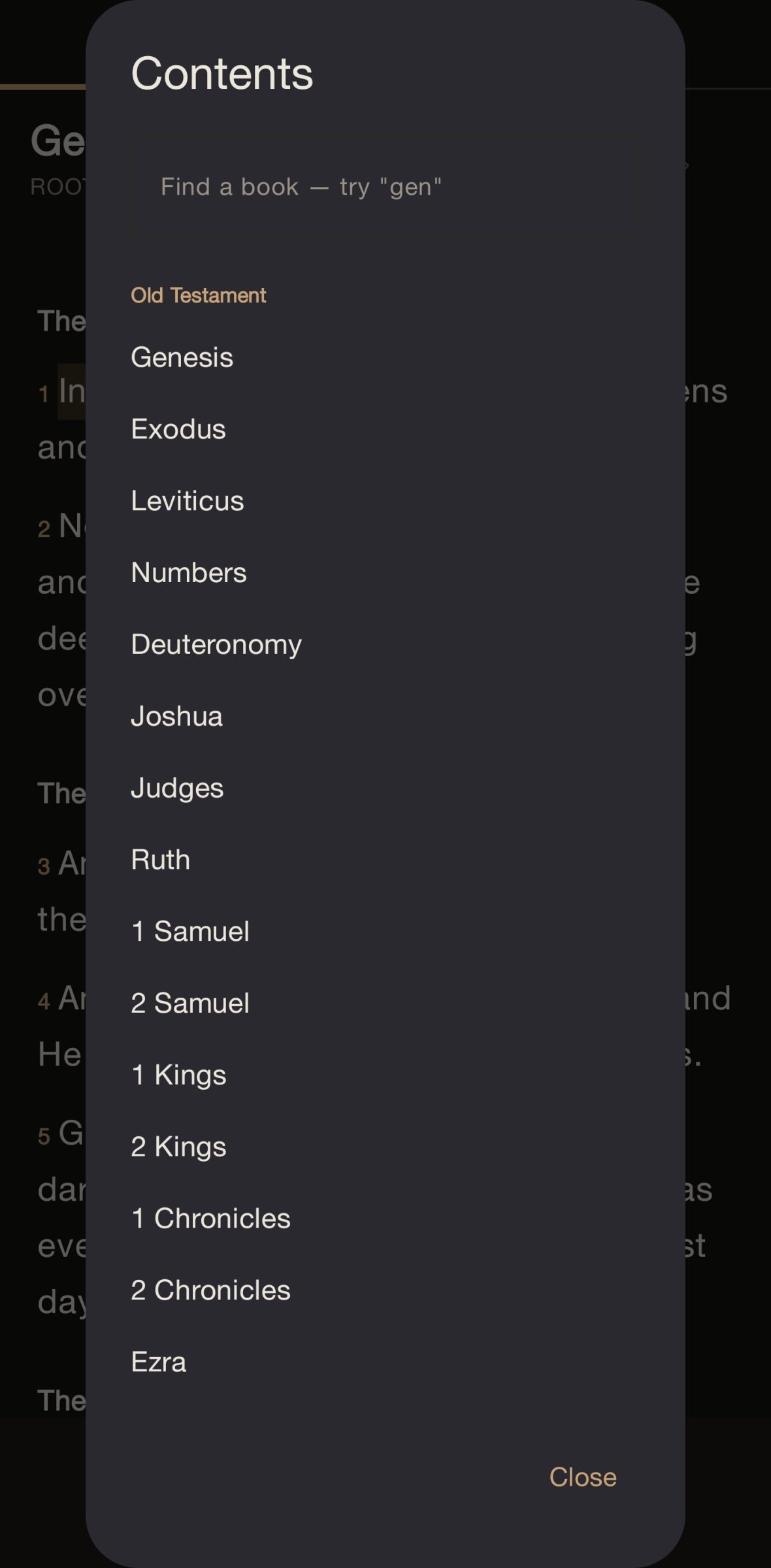
The text of all sixty-six books is on the phone from the moment you install it. No connection, no account, no login to open Genesis.
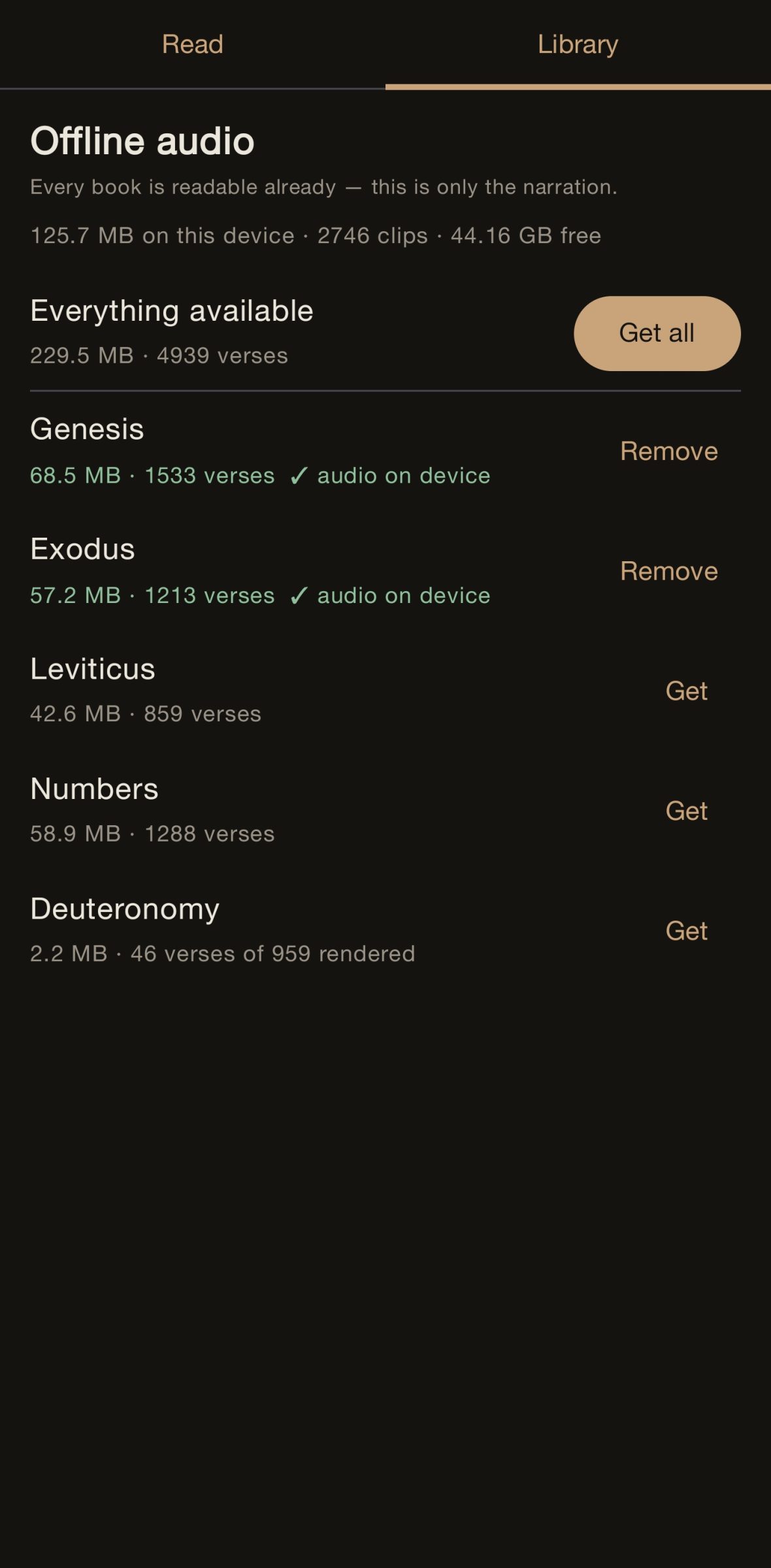
Audio is the only thing you ever download, because audio is the only thing that is genuinely large — the complete narrated Bible is roughly sixty-two hours of speech, about 1.3 GB. Nobody should have to carry all of that to listen to one psalm, so the library is per book, the size is shown before you commit, and removing it is one tap. Take the audio off and the book stays; you never lose the text.
Why the narration is AI, and why that is the point
Every verse is spoken by a synthetic voice, generated on hardware in my own office rather than through a commercial text-to-speech service.
This is not an experiment. We have been building AI narration into client work for a while now — course modules, training material, video projects — and over that time we have tuned our particular configuration and build-out until it stopped sounding like a computer reading a list. It has a natural cadence. It breathes in the right places. We use a custom voice we built ourselves, which is what makes the difference between narration you tolerate and narration you can listen to for an hour.
The practical advantage matters just as much: the audio comes out with no licensing restrictions attached. There is no per-character API bill, no usage cap, no clause about commercial distribution, and no third party who can change the terms once sixty-two hours of Scripture depend on them. A public domain text narrated by a voice we own, rendered on a machine we own, is a thing I can genuinely give away — and keep giving away.
It also means fixing something is cheap. If a word is mispronounced, I correct it and re-render that verse. Through a paid API, every improvement would carry an invoice.
I do not simply trust the output, either. Every clip is automatically transcribed back and compared against the verse it was meant to read, with particular attention to the proper nouns Scripture is full of — the Havilahs and Zerubbabels that defeat every text-to-speech system. Anything that fails that check gets flagged for a human ear.
It follows along while it reads
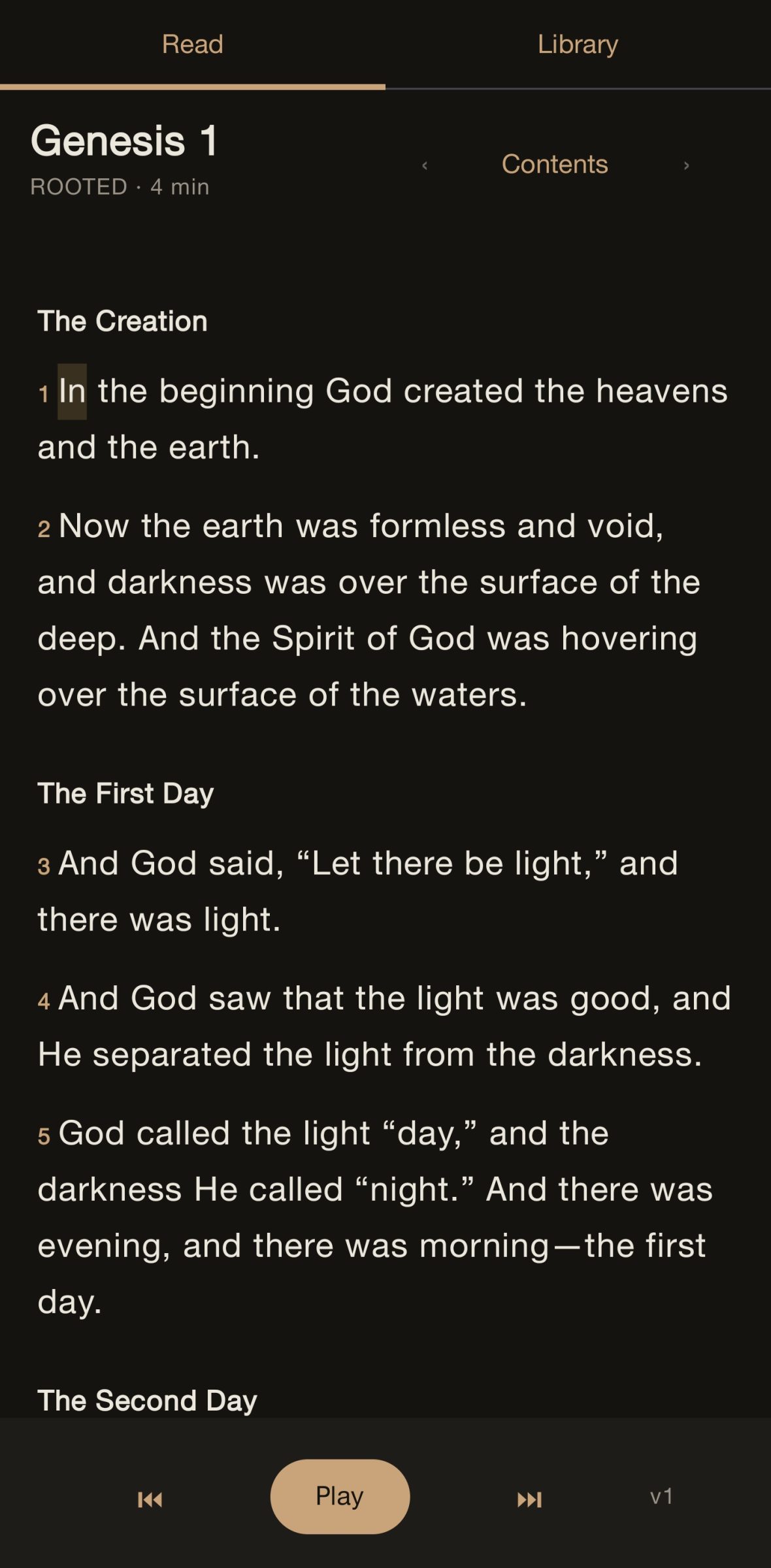
Because every clip is transcribed during that quality check, I get word-level timing almost for free — so the app highlights each word as it is spoken. It was not in the original plan and now I would not ship without it. It is useful for reading with children, for anyone working through English as a second language, and for keeping your place in a long passage.
What is coming
- Tap a verse for the interlinear. The one I most want. Tap any verse and see the original-language text underneath it, word by word — the Greek or Hebrew, its transliteration and what it actually says. This is not a bolt-on: every English phrase in the app is already linked to the original word behind it, because the Berean data is built that way. The wiring is in; the screen is not built yet.
- Strong’s concordance. From that interlinear view, tap through to the lemma and see everywhere else it appears in Scripture.
- Intelligent search. Not just matching letters, but finding the passage you are thinking of when you cannot quite remember the wording.
- Reading plans and playlists, including continuous listening across books — the Gospels in chronological order, for instance, rather than four passes through the same events.
- Other languages. The pipeline is not English-specific, and because the source text carries no licence, nothing stops it. This is the part I am most eager to get right.
Why Android first
People assume this is about Apple's developer fee. It is not — that is nominal. It is not really about having to buy Apple hardware to build for their platform either, though buying a Mac Mini to compile an app you are giving away for free is its own kind of annoying.
The real reason is app review.
My experience of that process, across other projects, is a steady pressure: adopt this new capability we have just launched, adjust that, and — the one that concerns me most — questions and nudges around monetisation and in-app purchasing. I do not want to spend the life of a free Bible app negotiating with a review queue about whether it ought to sell something.
Android is simply open in the way this project needs. You do not have to go through a store at all. You can sideload it — download the file and install it — which means the app can exist and be shared without a gatekeeper, and without a review process quietly shaping what it becomes.
That is how it will be distributed initially: a direct download, in early September. A Play Store listing may follow. An iOS version is not off the table. Neither is the point.
What I am doing before release
The text of the whole Bible is finished, proofed and in the app. The narration is rendering book by book on the machine in my office, and it grows every day.
Before this is released, I am going to listen to all sixty-two hours of it myself.
Not sample it. Not spot-check the hard chapters and assume the rest. The automated checks catch garbled words and missing phrases, and they have caught plenty — but no automated check hears that a sentence lands wrong, or that a name is technically correct and still sounds unnatural, or that a passage needs a breath it did not get. The only way to know that the whole Bible reads well is to go through the whole Bible.
That is the work between now and September. It is slow, and it is the part I am least willing to skip.
Would you test it?
I am looking for people who will actually use it and then tell me where it falls short — on a commute, in a kitchen, with a toddler on your lap, on a bad connection. If that sounds like you, send me a note through the contact form and mention the Bible app. I will send you the build and an honest list of what does not work yet.